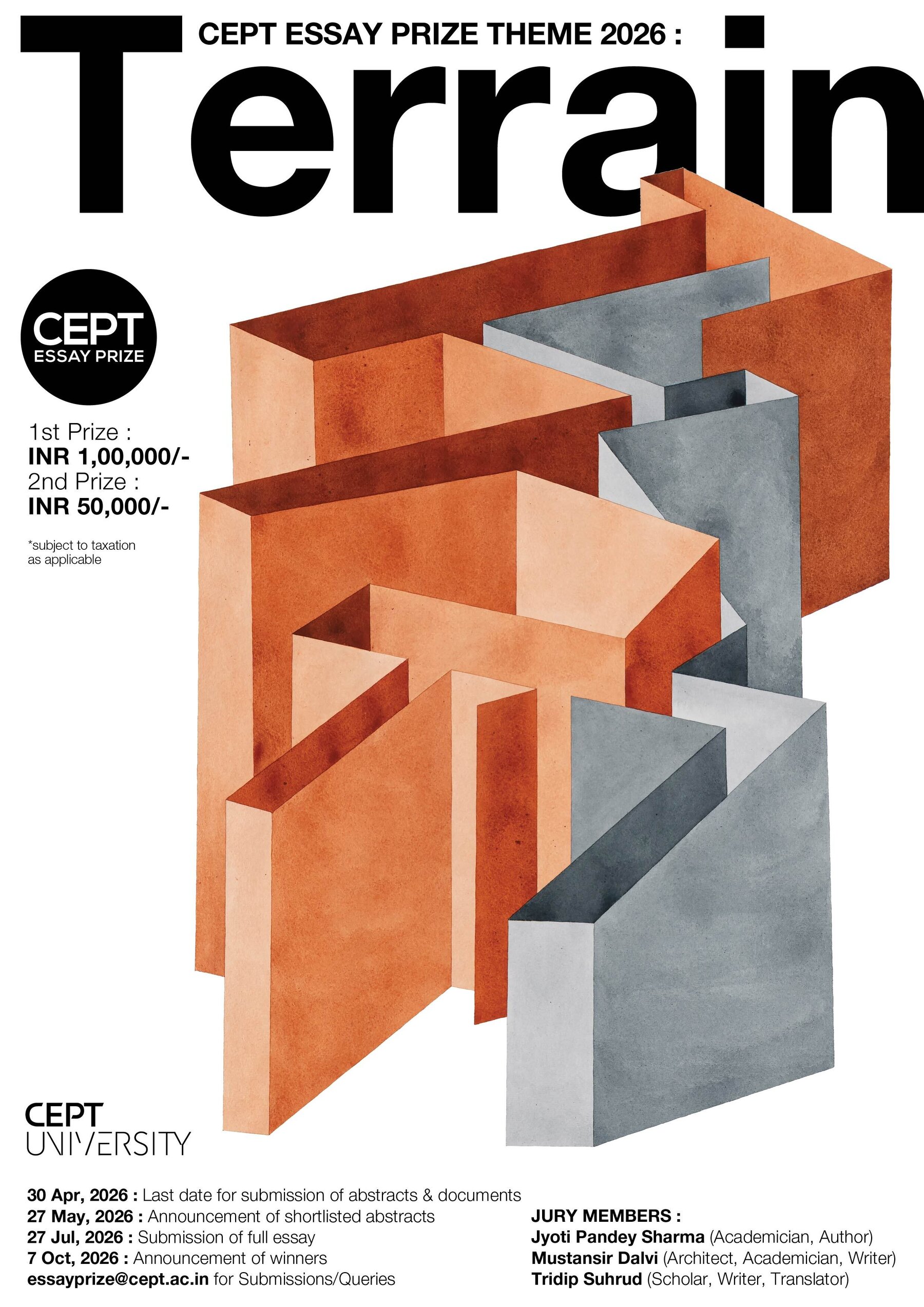
CEPT Essay Prize 2026

“I am rooted, but I flow.”
-Virginia Woolf, The Waves (1931)
The word terrain has its roots in the latin terra meaning land, earth, ground, or soil. It opens itself up to a broad contemporary understanding in terms of form, which may be hard, soft, fluid, even gaseous. The power of terrain lies in its substance or materiality. While lending itself to territory, it becomes a boundary constituted by humans but at the same time constitutes them. It is of a scale which subsumes the human and even outlives it. Scholars argue that in times of a climate crisis, understanding terrain in its multiplicity which gives it an opacity and resilience, would establish its primacy over human-made territory. It also renders itself to becoming a significant component in shaping the uniqueness of peoples and their struggle for justice in this global capitalist economy.
Terrain is all around us — beneath our feet, within sightlines, in the spaces we pass through every day. Never fixed, never fully revealed, always in relation, always in motion, terrain remains a space to dwell with, to watch, to imagine, and to let linger. It is to see how human and non-human forces meet and negotiate, how control and contingency coexist, and what seems stable is never fixed.
As a concept, terrain consequently shifts the scales in favour of a discourse against anthropocentrism, for a ‘multispecies becoming-with’ and worlding. It urges for a less fragmented, more equal world that is on the path to justice. Instituting terrain at the core of discussion in art, architecture, design, technology, social sciences, and other fields, will invoke a politics of multiplicity, of the material, of the collective, of the elements. CEPT Essay Prize 2026 invites young writers to reflect on the ways to bring an embodied engagement with our planet and offer it the respect it commands in-itself in a non-Eurocentric, indigenous, and situated manner.
Keywords: terrain, architecture, urban planning, design, humanities, social sciences, literature, territory, landscape, materiality, cultural narratives, elements, urban spaces, city studies, indigeneity, relationships, histories, everyday life, art, aesthetics, time and space, infrastructure, resilience, climate change, justice, human rights, planetarity, anthropocentrism, Global South, South Asia, Southeast Asia.
- The writing should be accessible to a wider readership beyond the architecture and planning audiences; and it should also be able to connect with readers across the world beyond South and South-East Asia.
- Clarity of thought and simplicity of language will be preferred.
- Directness of communication or arguments presented is encouraged.
- Graduates from any allied areas of architecture, planning, interior design, sociology, literature, and urban design, under the age of 30 years (not more than 29 yrs 11 months as on 30-Apr 2026) are eligible to apply.
- Only individual/single author entries are allowed.
- Any candidate can apply to the CEPT Essay Prize for a maximum of two cycles; however, those who have been awarded the first or second position in any cycle are no longer eligible to apply for a subsequent cycle.
- The essay competition will be held in two stages.
- First, we invite participants to submit an essay abstract of about 500 words, along with their CV, proof of last academic degree attained and DOB (date of birth).
- A panel of experts will blind-review the abstracts and shortlist the entrants.
- The selected participants will be required to submit a long-form essay of 3000 words (excluding references), which will be further blind-reviewed by a panel of eminent jurors.
- Submit the abstract and documents for entry to the competition on this Google Form.
- The final essay (if you are shortlisted) will be submitted by email to: essayprize@cept.ac.in
CEPT Essay Prize: Technical Writing Guidelines for Essay
1. Type and Layout
- The text should be written using Times New Roman, font size 12, with 3 cm margins on the page.
- Pages must be numbered sequentially from the first to the last page of the full essay.
- The document should be unlocked/editable and should not contain ‘track changes’/revision marks— hidden or otherwise.
- The essay should mandatorily have a title and subtitle, which should be mentioned on a separate title page.
- Maintain consistency in text style throughout the typescript.
2. Use American English for the essay
- British English v/s American English examples ‘-ize’ ‘-ization’ (apologise-apologize, recognise-recognize, organise-organize). The same applies for differences in British and American spellings of words that end in ‘re’ (centre-center, fibre-fiber, litre-liter), ‘our’ (colour-color, flavour-flavor, humour-humor), ‘yse’ (analyse-analyze, paralyse- paralyze), double vowels (leukaemia-leukemia, manoeuvre-maneuver, paediatric-pediatric, diarrhoea-diarrhea). When using the Americanstyle, use commas after i.e., e.g., and etc.
3. Abbreviations and Periods
- An abbreviation that is a contraction, i.e., one that retains its first and last letters, should appear without a stop, e.g., Mr, Ms, Mrs, Dr, St (for Street). Saint is abbreviated with a stop (St.), as in St. Peter, St. Thomas, St. Teresa, or a place name like St. Tropez.
- But an abbreviation that does not retain its original last letter must appear with a stop, e.g., Prof., Maj., Capt., vol.,
- For abbreviated names, there are stops and spaces between initials, e.g., A. P. J. Abdul Kalam.
- There are no stops in measurements, even though there are spaces, e.g. 7 cm, 11 kg
- There are stops and spaces after abbreviated names of parts of a book, e.g. vol. 5 (Or v. 5), no. 3, sec. 11, p. 92, pp. 23-27
- Do not use ‘&’ in place of ‘and’ except in an abbreviation. Thus, Jammu and Kashmir, not Jammu & Kashmir; but J&K, not J and K.
- There are no stops in abbreviated names of states like UP, MP, AP, WB.
- It is fine to use commonly understood abbreviations like USA and UK or TV (not tv) and CD (not cd).
- Write phrases like aren’t and shouldn’t as are not and should not. Do not abbreviate them.
4. Quotes and Citations
- APA style manual should be used for in-text citation.
- Please cite all material directly quoted from other sources, of whatever length, with quote marks and proper citation of the source as failing to do so will bring legal problems.
- All direct quotes must include the page number of the book in which the quote appears: (Chandra, 1999, p. 27).
- Quotes that are longer than 50 words should be set apart from the main text and indented.
- For all material sourced but not directly quoted from elsewhere, please provide citations.
- All tables and figures reproduced from elsewhere must include citations with page numbers. (Details in point 14)
Quotation marks and adjacent punctuation
- Commas and stops should go inside the quotation marks, even when they are not part of the original quotation. For example, “The best investments today,” according to Smith, “are commodities and emerging-market stocks.” and not “The best investments today”, according to Smith, “are commodities and emerging-market stocks”.
- Besides commas and periods, all other punctuation marks, like a colon or a semicolon, are placed outside quotes.
5. Comma
- Commas can present significant problems, with many rules and technicalities. It is best to keep New Hart’s Rules handy.
- Whether or not to use a comma before ‘and’ or ‘or’ in a list of three or more items is one of the classic debates on punctuation. Such a comma is called a ‘serial comma’ or an ‘Oxford comma’ (from its traditional use in Oxford University Press publications). e.g., a thief, a liar, and a murderer (as opposed to ‘a thief, a liar and a murderer’), or a government of, by, and for the people (as opposed to ‘a government of, by and for the people).
- We prefer that you use the Oxford comma. Using the last comma can help in resolving ambiguity in some cases. (An example is the title of Lynne Truss’s famous book ‘Eats, Shoots & Leaves’, which has spawned jokes involving pandas and cowboys.)
6. e.g., i.e., etc., et al.
- Be aware that e.g. (for example) is not the same as, or interchangeable with, i.e. (that is), or viz. (namely).
- Both e.g. and i.e. should be written in lower-case roman, with two points and no spaces.
- We prefer that they are followed by a comma, as is often in the American practice.
- A comma, colon or dash should precede ‘e.g.’ and ‘i.e.’. For example, A variety of fruit, e.g., apples, oranges, bananas, and cherries.
- et al. is Latin shorthand for ‘and others’. Use lower-case roman, with a full point, even though et al. is sometimes italicized in bibliographic use.
7. Dates
- In running text, spell out the nineteenth century rather than the 19th century (but ‘19th cent.’ or ‘19th c.’ are acceptable in notes).
- 1820s (no apostrophe), not 1820’s
- 6 August 1949. If the day of a week is given, then comma after: ‘Sunday, 25 October 1953.’
- 1992–93, not 1992–3
- ‘AD’ and ‘BC’ should be marked for small capitals; ‘AD’ comes before the year, ‘BC’ comes after it. (e.g., AD 1556, but 326 BC)
8. En and em dash
- Use en dash for inclusive numbers e.g., pp 66-70 or centuries e.g., 1898-1921.
- Use en dash for compound words not ordinarily hyphenated (the London-New York flight, the Harris-Todaro model)
- Use em dash to separate clauses. No spaces are required before or after the em dash. For example: (1) A possible scenario is where women negotiate—or should we say appropriate—more autonomy. (2) If discretionary elements dominate—which is unlikely—policy coordination becomes more complex.
9. Numbers and percentages
- Use one to ninety-nine in words and then on in numbers (100, 101, 102, etc.).
- In numbers (excluding page numbers, addresses, years), commas should be used between groups of three digits, starting from the right. For example: 52,071; 7,251; 2,000,834.
- For inclusive numbers (page numbers and years), two digits (or more if necessary) are used for the second number. For example: 321–28; 426–683; 1893–96; 1588–91; 1684– 1723.
- All exact numbers that appear before measurements, weights and percentages are in figures, not words: Percentage (3 per cent), distance (4 km), measurement (2.5 inches), weight (3 kg) and age (3-year-old child). Sentences should never begin with a number. In such cases either rewrite the sentence so that the figure appears as the third or fourth word, or express the figure in words.
10. Diacritics
- If diacritical marks are used for words in Urdu, Hindi, Sanskrit, or any other language, they should be consistent and correct. Please clearly insert diacritics on the soft copy of the essay. For example: Śiva or Shiva, not Siva.
11. Capitalization
- Most publishers discourage the use of excessive capitalization. No set of rules for capitalization can be universally applied. Some authors may have particular and valid reasons for capitalizing certain terms normally lowercased in other works. When authors depart from the usual patterns, they should inform their publisher by providing a list of terms involved.
12. Hyphenation
- Again, there are no universal rules. Hyphens should in general be used sparingly and with consistency, and their primary purpose should be to avoid ambiguity or confusion.
Some rules to remember:
- Do not hyphenate adjectival compounds when the first element of the compound is an adverb ending in –ly. For example: A happily married (not happily-married) couple, a newly discovered (not newly-discovered) planet.
- Do not hyphenate italic foreign phrases, unless they are hyphenated in the original language. For example: an ex post facto decision, an ad hominem argument, suo motu action.
- Once foreign phrases have become a part of the language and are no longer italicized, they are treated like any other English word and hyphenated (or not) accordingly: For example: A laissez-faire policy; He handled the problem with his usual savoir faire.
- Words with prefixes are often written as one word but use a hyphen to avoid confusion particularly where there is a collision of vowels and consonants. For example: anti-intellectual, non-negotiable, pre-eminent, re-entry. (It may be confusing to see a word like antiintellectual or nonnegotiable in print.)
- Please note that hyphens are not used in ‘cooperate’ and ‘coordinate’ despite the collision of Os.
- Hyphenate prefixes before a capitalized name, number or a date. For example: Anti-Darwinism, Sino-Soviet, Pre-1990s.
- Suffixes are always hyphenated or closed, never with a space. Use a hyphen for newly coined combinations with -like. For example: Tortoise-like, Paris-like but the more common combinations need not be hyphenated—ladylike, catlike, childlike. The suffixes –proof, –scape, and –wide usually need no hyphen. For example: childproof, nationwide, landscape.
- Use hyphens in spelled-out numbers from 21-99.
- Compass points are not hyphenated in American usage. For example: southeast, south-southeast.
- Capitalized compounds are usually not hyphenated. For example: South Asia, Southeast Asia.
- Use hyphens when an element is omitted in a series. For example: two-, three-, or fourfold; upper-, middle-, and lower-class accents. These are only broad guidelines.
13. Word breaks
- Words should be broken/divided at the end of lines where necessary according to pronunciation or syllable—for example, demo-cracy, de-sign, develop-ment, etc.
- Hyphenated compounds should only be broken at the hyphen—for example: inter-cultural and not intercul-tural.
14. Tables, Figures, Charts, and Maps
- All tables and illustrations (figures, maps and photographs) must be numbered sequentially (e.g. Table 1/ Figure 1), and must carry titles and indicate the source(s) of the data, when it has been taken or adapted from secondary sources. e.g., Figure 1. Caption. Source: Hindustan Times, February 2002.; Figure 5. Caption. Source: M. Mamdani, 2022.
- The sources of all tables and other illustrative material can be provided in the reference list, under “References”.
- The placement of each of these in the text should be clearly indicated and the reference to them should be by number (see figure 3) and not location (see figure below)
- The data provided in tables, figures and maps should be accurate. All totals must be checked, X and Y axes must be consistent, and all units of measurement stated.
- If the text carries a map of India, it must be vetted by the Survey of India. Foreign publications carry a map of Jammu and Kashmir, which India does not accept. Getting the map wrong can attract legal action.
15. Non- English Words
- All non-English should be italicized on first appearance. They should ideally be explained in the body of the text, or as endnotes, if a detailed explanation is required.
16. Referencing Style
- Use APA style sheet for referencing and citation.
In-text citations
- Use parenthetical and narrative citations when you are quoting, paraphrasing or summarizing a source. Direct quotations require page numbers to be cited.
- In a parenthetical citation, both the author and the date, separated by a comma, appear in parentheses, and it can be placed within or at the end of a sentence. For example, Falsely balanced news coverage can distort the public’s perception of expert consensus on an issue (Koehler, 2016).; (see Koehler, 2016, for more detail); (e.g., falsely balanced news coverage; Koehler, 2016); (Jones, 1998, p. 199); (Jones, 1998, pp. 199–201). When the source does not have page numbers, as in an e-book or web document, use another identifying element, like chapter or paragraph number. For example, Jones (1998) found a variety of causes for student dissatisfaction with prevailing citation practices (paras. 4–5).
- For narrative citations, the author’s surname appears in running text followed by the date in parentheses at any place in a sentence. For example, According to Jones (1998), "students often had difficulty using APA style, especially when it was their first time" (p. 199).; Koehler (2016) noted the dangers of falsely balanced news coverage.; In 2016, Koehler noted the dangers of falsely balanced news coverage. In the latter, both date and surname are part of the running text, hence, no parenthesis is used.
Endnotes
- Endnotes: Explanations or amplifications are provided in the endnotes when they cannot be accommodated within the body text.
- Endnotes are placed at the end of the essay. Note that reference numbers in the text should come superscripted at the end of a sentence, or at least at the end of a clause. When material is quoted, the note number should follow the quotation, before the in-text citation.
- Endnotes should be consecutively numbered with superscripted serial numbers, beginning with 1 (Arabic numerals), throughout each chapter in the typescript.
- A note should consist of more than a mere reference and should not include the details of the reference. For example: The building of Constantia had started by June 1796. See Llewellyn-Jones, 2003b, p. 287. The details of Llewellyn-Jones should appear in the References at the end of the essay.
References
- The reference list should match every cited source in the text. Carefully check the name/s of the authors and the spellings of their names.
- Use APA consistently. This document may be helpful as a ready reference. For a detailed guide, refer to https://apastyle.apa.org/style-grammar-guidelines/references/examples.
17. Images and Illustrations
- All images/maps/illustrations (if used) should be in black and white as the book is published in black and white.
18. Use of AI (adapted from APA and COPE)
- Here, AI refers to generative LLM AI tools and does not include grammar-checking, citation management, or plagiarism-detecting software.
- When a generative AI model is used in the drafting of the manuscript, production of images or graphical elements of the paper, or in the collection and analysis of data, the use of AI must be disclosed and cited in a relevant section of the paper or as a separate enclosure on how the AI tool was used and which tool was used.
- Authors are fully responsible for the content of their manuscript, even those parts produced by an AI tool, and are thus liable for any breach of publication ethics. This means that authors must verify any information and citations provided to them by an AI tool, including verifying the information received via generative AI searches by reading original sources used in AI output. Authors may use, but must disclose, AI tools for specific purposes such as editing.
- Additionally, please note that when information is entered into generative AI, the organization which runs the generative AI will likely have access to this data. Authors should be aware of this possibility and how it may impact the privacy of participants in their studies, as well as how it may impact their own privacy and intellectual property.
- Authors need to provide attribution to the generative AI tool in cases where the tool was used to generate ideas, content, analysis, code, or research elements, as you would provide attribution to a human contributor.
- We recommend that authors preserve the output of generative AI in their private records in case it is requested during peer review or after publication. Researchers should document for their own records the prompts used with AI tools. To the extent that it helps readers, these prompts can be included where the AI use is disclosed, or elsewhere as appropriate, such as an appendix.
- For citing AI, this link may be helpful.
CEPT Essay Prize Committee:
Shabeeh Rahat (Convener | Researcher, Teacher, Learner)
Shabeeh Rahat is a researcher-teacher-learner. She has a doctorate in English Literature and specializes in Postcolonial Studies with reference to India. Her research interests lie in studying disadvantaged groups of South Asia through literatures across English, Hindi and Urdu. She published a poetry collection in Hindi as a 13 year old, and later a poem in English in an international anthology. She also translates from-and-into Hindi-Urdu-English. Her translation pieces of Premchand's nonfiction prose have been published. Her academic work is published as book chapters, journal articles and conference proceedings, and regularly presented at conferences and seminars. Two of her book chapters are in the pipeline for international edited volumes. She received the Professional Development Grant by the Modern Language Association (MLA) in 2023. She is a member of reputed organizations like South Asian Literary Association, Comparative Literature Association of India, TRACTS Network: Traces as a Research Agenda for Climate Change, Technology, & Social Justice, and Research Network for Interdisciplinary Studies of Transhistorical, Deliberative Democracy.
Mansi Shah (Urban Designer, Landscape Researcher, Educator)
Mansi Shah is an architect-urban-designer. She is based in Ahmedabad and teaches in Bachelor of Urban Design, as an Adjunct Professor at CEPT University. With teaching, she works on her independent research projects on different subjects under ‘Productive Urbanism Collective’ (a research collaborative focused on urban landscapes as productive and performative spaces), ‘Ahmedabad Mapping Project’, and City Water Walk. She has co-authored the book ‘Rebel Bodies Rebel Cities’, published by CEPT University Press in 2022. It is a teaching and research project that examines the complexities of urban public spaces and the importance of acknowledging competing stakeholder interests to create more inclusive and equitable environments. She has also co-authored the book ‘Prathaa: Kath-khuni Architecture of Himachal Pradesh’ as a senior researcher at the Design Innovation and Craft Resource Centre (DICRC), CRDF, CEPT University.
Sonal Mithal (Conservationist, Academician, Author)
Sonal Mithal (she/her) is an architect, artist, and educator. She holds a doctorate from University of Illinois at Urbana-Champaign, MArch from SPA Delhi; and BArch from Lucknow University. She is co-founder of research and conservation studio, People for Heritage Concern which offers consultancy for conservation and urban revitalization projects, and art projects for the public sector. She is serving as chair of the Masters in Conservation and Regeneration program at CEPT University. Her research, teaching, and writing transects architecture, landscape architecture, queer studies, history, and architectural conservation. Her areas of interest are architecture approaches for climate change, feminist-materialism, and intersectionality which is central to shaping the built environment. She has recently published A Queer Reading of Nawabi and the Colonial Archive: Lucknow Queerscapes (Taylor and Francis UK, 2024), IncLOOsive: Feminist Toilet Architecture (CEPT University Press, 2025), and Living together: More-Than-Human Ecologies for Architectural Thinking (Birkauser, 2025).
Administration
Aarti Bhoorat- Dy. Manager, Doctoral Office, CEPT University
Jyoti Pandey Sharma
Jyoti Pandey Sharma is a Professor of Architecture at Department of Architecture, School of Planning and Architecture, New Delhi and is currently heading the Department. She graduated from Chandigarh College of Architecture, and her doctoral work, was undertaken at De Montfort University, United Kingdom. She critically engages with architectural and urban history, and built heritage and cultural landscapes largely focussing on the Indian Subcontinent’s Islamic and Colonial eras. Her research is widely published as research papers; chapters in multi-author volumes, an edited volume and a monograph. She has been an invited speaker at a number of international symposia and conferences. Her research has also received several awards and fellowships. She has been a Summer Fellow at Dumbarton Oaks Research Library and Collection, Harvard University and a UGC Associate at the Indian Institute of Advanced Study, Shimla, India.
Mustansir Dalvi
Mustansir Dalvi is Adjunct Faculty at Sir JJ School of Art, Architecture and Design (de novo deemed to be university) and oversees the postgraduate program on Metropolitan Architecture. He was Professor at Sir JJ College of Architecture until 2024, retiring as the longest serving Professor of Architecture in the University of Mumbai. During this time, he was member, Academic Council and chairperson, Board of Studies at the University of Mumbai. He received his PhD Degree from the Indian Institute of Technology-Bombay in 2017. Dalvi is the editor of 20th Century Compulsions (Marg, 2016), a collection of writings about early Indian modernist architecture. His newest book is Citizen Charles: the first biography of architect Charles Correa (2024, Niyogi Books).
Tridip Suhrud
Tridip Suhrud is a scholar, translator, engaged in understanding the life of and thought of M K Gandhi and the mind of modern Gujarat. His recent works include the critical editions of M K Gandhi’s Hind Swaraj and the Autobiography, a two-volume project on editing and translating The Diary of Manu Gandhi, has translated into English the four part canonical Gujarati novel Sarasvatichandra and is currently working on a possible nine volume project, Thumb Printed (three volumes published) on the testimonies of indigo cultivators of Champaran. Tridip Suhrud is a Professor and Provost of CEPT University, Ahmedabad. He is also a Director of Lalbhai Dalpatbhai Institute of Indology, Ahmedabad and serves as Chairman of the Governing Council of MICA.
- First Prize: INR 100,000*
- Second Prize: INR 50,000*
- Honorary mentions
*subject to tax deduction as applicable
Selected top essays are published as CEPT Essay Prize book (with ISBN) by CEPT University Press. All the contributors are awarded a certificate and a complimentary copy of the book as a token of appreciation and participation. Additional copies of the books can be bought through CEPT Press.
- Last date for submission of abstracts & documents: 30 Apr, 2026
- Announcement of shortlisted abstracts: 5 Jun, 2026
- Submission of full essay: 26 Jul, 2026
- Announcement of winners: 6 Oct, 2026
Submission of abstract & documents: Google Form. - Prize event/ceremony: To be announced later
The applicants must submit an original and well-rounded 500-word abstract for the competition entry, clearly articulating the objective and intent of the essay.
Please follow the technical guidelines elaborated on the website. The selected candidates should ensure their full essays are suitably edited for language, grammar, consistency in referencing, etc., before submission of the essay. CEPT Essay Prize reserves the right to consider well-written, edited, and well-thought-out essays only.
The submissions must ensure grammar edits and language corrections as a basic requirement for the first round of selection.
CEPT University
Kasturbhai Lalbhai Campus
University Road, Navrangpura
Ahmedabad 380009
Email: essayprize@cept.ac.in
Phone: +91-79-68310000 | Ext No: 207