Ecosystem for Entrepreneurship
Ecosystem for Entrepreneurship
With the objective of building an integrated, university-based innovation ecosystem that supports the ideas and innovations of students and faculty, CEPT University has been steadily strengthening outcomes driven by design, planning, and technology.
Over the last four years, the IPR & Innovation Cell has put in place strong systems and processes to harness and protect creative work emerging from the University. This includes safeguarding innovations through patents, industrial design registrations, copyrights, and enabling the development of proof-of-concepts and prototypes through financial support. To date, 55 IPRs have been registered, comprising 52 design registrations, 2 copyright registrations, and 1 patent registration. A total of 30 IPR applications are currently under process, reflecting a growing pipeline of protected knowledge and design outputs.
Innovation Embedded in Pedagogy
A culture of independent thinking and creativity is fostered through CEPT’s studio-based learning, where students engage with real-life challenges within the wider context of the habitat and built environment. The studio environment supports different interests and learning styles, guided by faculty, peers, and industry experts.
An interdisciplinary approach helps students navigate the complexities of the design process, encouraging exploration, critical inquiry, and innovation. Coursework, seminars, and skill-enhancing workshops strengthen design thinking and analytical abilities, while emerging and digital technologies expand opportunities to prototype and test ideas.
Learning is further supported by CEPT’s exceptional infrastructure, including one of India’s finest academic libraries and state-of-the-art workshops equipped for diverse materials and digital fabrication processes such as 3D printing and laser cutting.
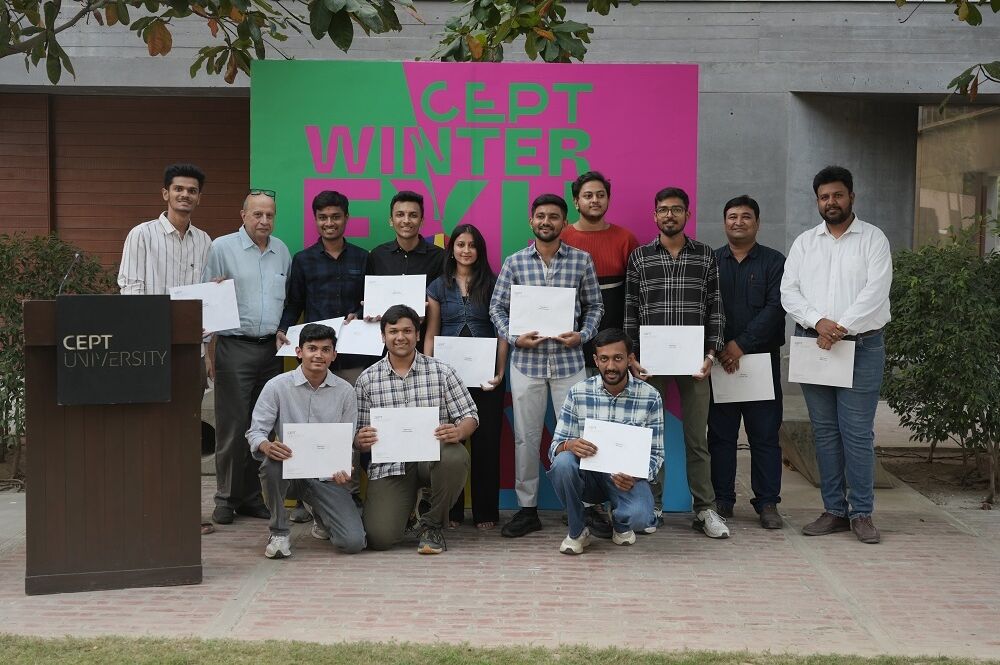
Summer and Winter programmes further reinforce the culture of experimentation and innovation. These short, intensive courses (2 – 4 weeks):
- Provide exposure to new and emerging themes
- Enable in-situ learning and context-specific exploration
- Encourage hands-on experimentation to learn by making
- Offer opportunities to collaborate with professionals and global experts
Through this well-rounded learning environment — combining studios, summer and winter programs, professional exposure, and innovation support — CEPT prepares students to apply their ideas in practice, address real-world challenges, and contribute meaningfully to future professions.