The collection in Saint-Mandé, France, where Bernard Kohn’s archives are currently located, was facilitated by the support of his family and our collaborator Joonoh Kim.


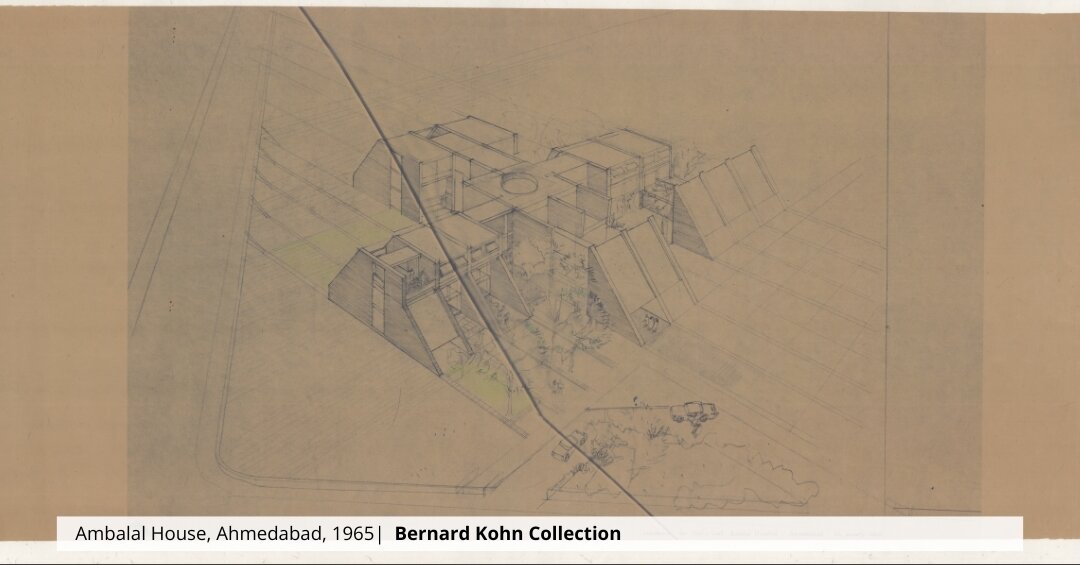

Joonoh was an international exchange student at the Faculty of Architecture at the CEPT University from 2023 to 2024. His interest in Kohn’s work grew while in Ahmedabad, which led him to visit Kohn in Le Puech. There, following Bernard Kohn’s recommendation and with the support of his family, Joonoh began working as a researcher and archivist at Bernard Kohn’s archives in Saint-Mandé. The collection reached the CEPT Archives from Saint-Mandé through this sustained engagement and will soon be available for reference and research to anyone interested.
Part of this collection was also contributed by Professor R. J. Vasavada to the CEPT Archives in 2025. We at the CEPT Archives remain grateful to him for enriching the collection through the donation of Bernard Kohn’s work. The collection also includes an oral history interview of Bernard Kohn conducted by the CEPT Archives in August 2014. The oral history can be accessed by writing to the Archives.


Born in France in 1931, Bernard Kohn trained as an architect at Columbia University from 1951 to 1955 and the University of Pennsylvania from 1958 to 1960 under Louis I. Kahn, and briefly taught at Yale University. In 1962, he arrived in Ahmedabad, where he co-founded the School of Architecture with B.V. Doshi and R.N. Vakil. As Deputy Director, he helped shape an experimental pedagogy rooted in Patrick Geddes’ “Folk – Work – Place,” advocating for an education grounded in direct engagement with people, environments, and lived realities. Students were encouraged to move beyond the classroom into villages, sites, and communities, approaching architecture through social, political, ecological, and cultural lenses.
Kohn’s work in India extended from pedagogical experiments to projects such as the Sabarmati Riverfront plan and Village Studies in Gujarat. Returning to France in 1969, he continued to develop his ideas through teaching, public institutions, and practice. His work increasingly centred on participatory, co-founding the multidisciplinary practice Environnement et Comportement, initiating pedagogical experiments such as the Antenne pédagogique de Cergy-Pontoise, and developing architectural and urban projects that involved users as active participants in the design process.


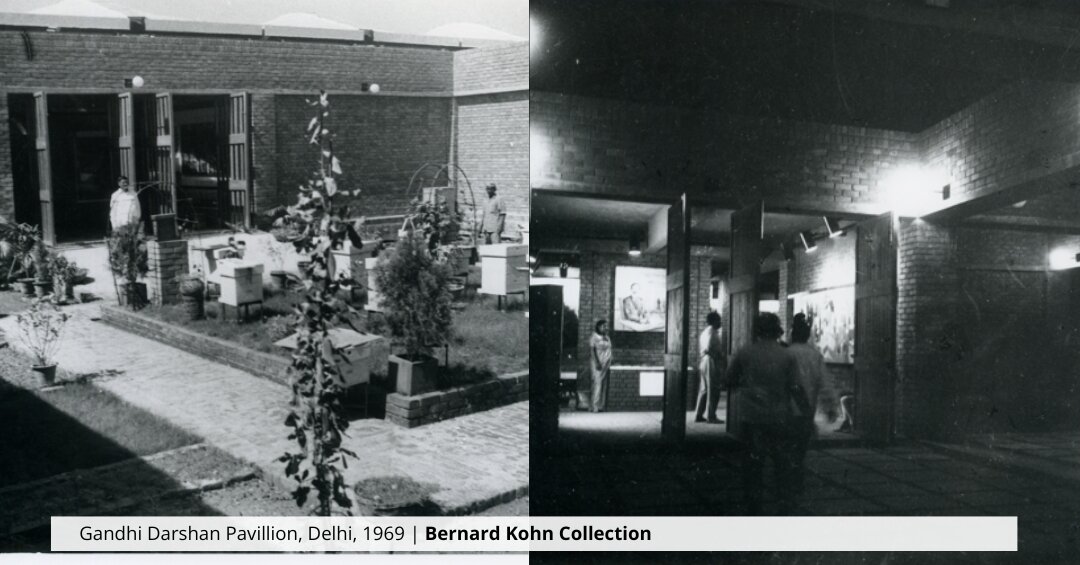
Between 1973(In 1973, Bernard Kohn ended his career as a professor at the Antenne pédagogique de Cergy-Pontoise in order to devote himself to his architectural practice) and 2011, Kohn worked on several projects. Some of them are the Cultural Action Center in Saint-Avoid (1985), the Royer Bendélé complex in Gennevilliers (1991), the courthouse of Clermont-Ferrand (1992), the renovation of the Vieux Colombier theatre (1994), the French embassy in Mexico City (1995), the courthouse of Montpellier (1996), the architectural design guide and six stations for Paris Metro Line 14 (1998). He has also published various books, namely ‘From domestic spaces, to the entire city, a succession of appropriations’, ‘Maison de Ville’, and ‘An experimental approach to architectural and urban design’