Transfer of Development Rights (TDR) market in Chennai — Assessing demand

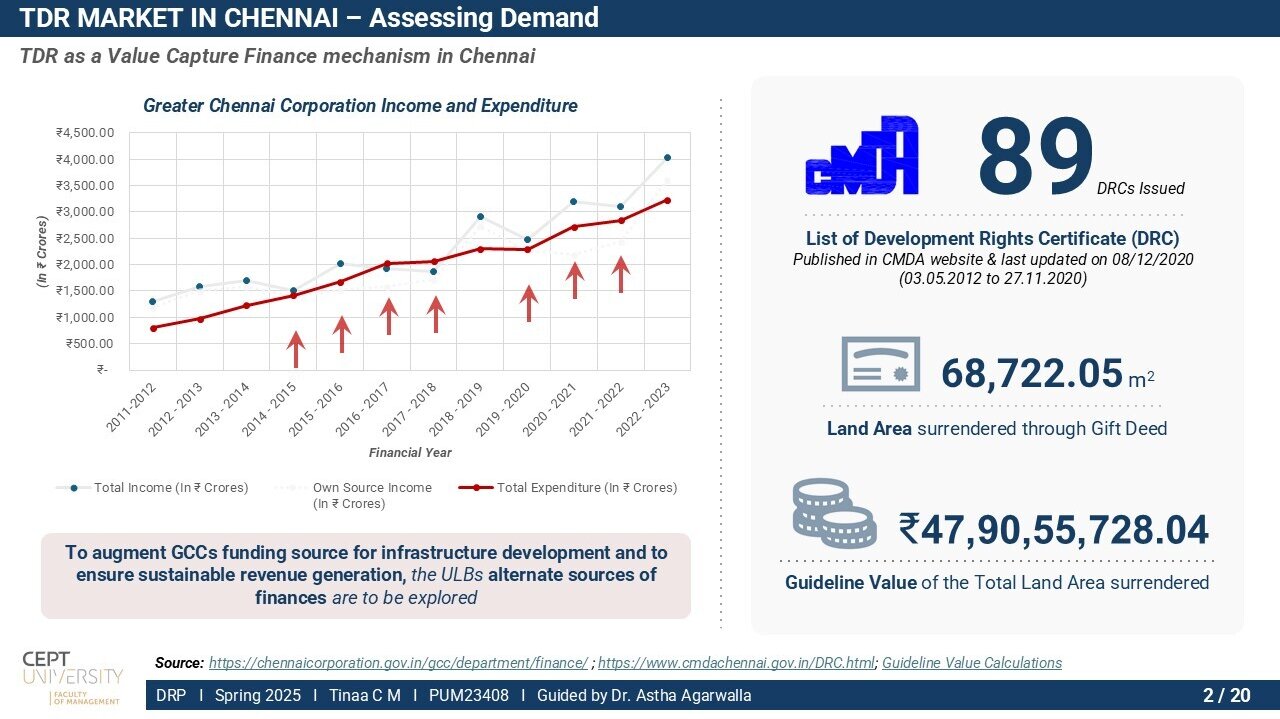
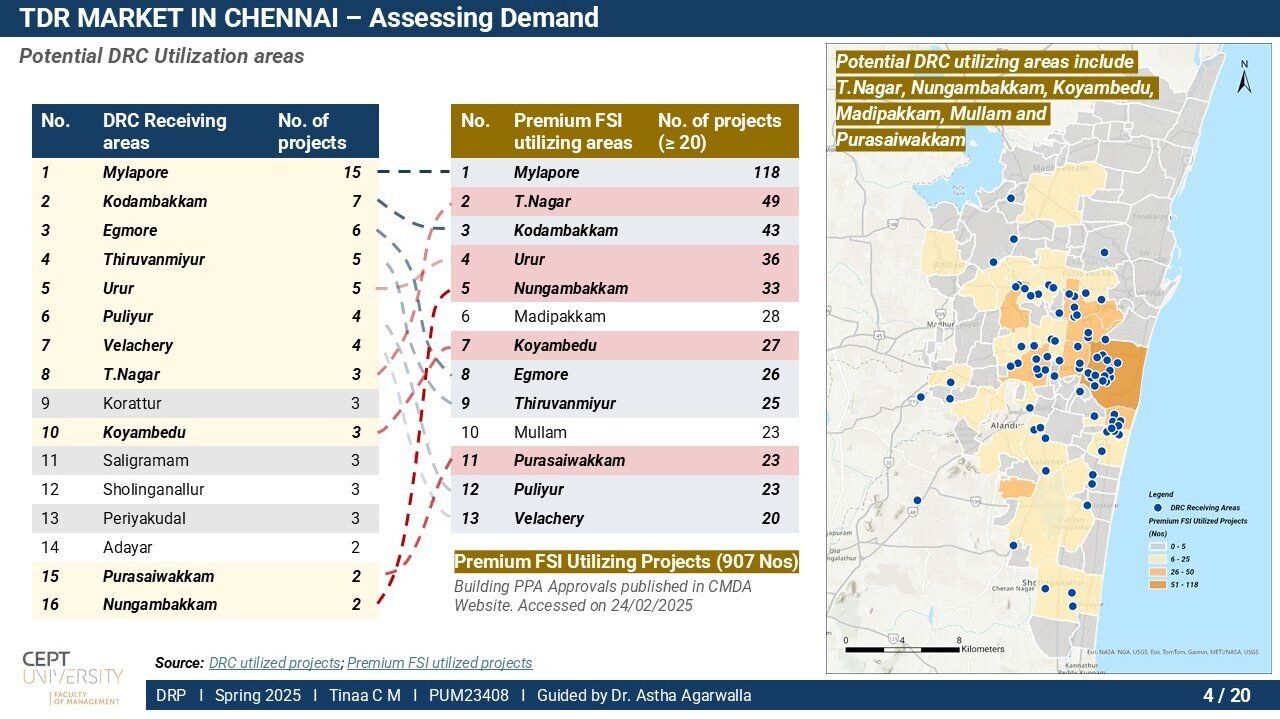
India’s rapidly growing urban population will reach 600 million by 2036, requiring an estimated $840 billion in infrastructure investment. Urban Local Bodies are exploring Value Capture Finance tools, including Transfer of Development Rights (TDR), to meet these demands. This study examines TDR both as a revenue mechanism and as an instrument for shifting development rights from constrained sending areas to growth-ready receiving areas. Using CMDA and TNRERA datasets, the study finds very low TDR utilization—only 3% of 2,801 planning applications used DRCs, while 32% opted for Premium FSI. Key factors influencing TDR use include Premium FSI charges, road width, number of units, and guideline values. Spatial analysis shows no strong pattern, though several high-value Chennai localities exhibit higher potential for TDR use. Recommendations include improving transparency through digital DRC information, incentivizing targeted development, carefully introducing Green TDRs, and expanding TDR adoption among smaller projects and lower-value areas.
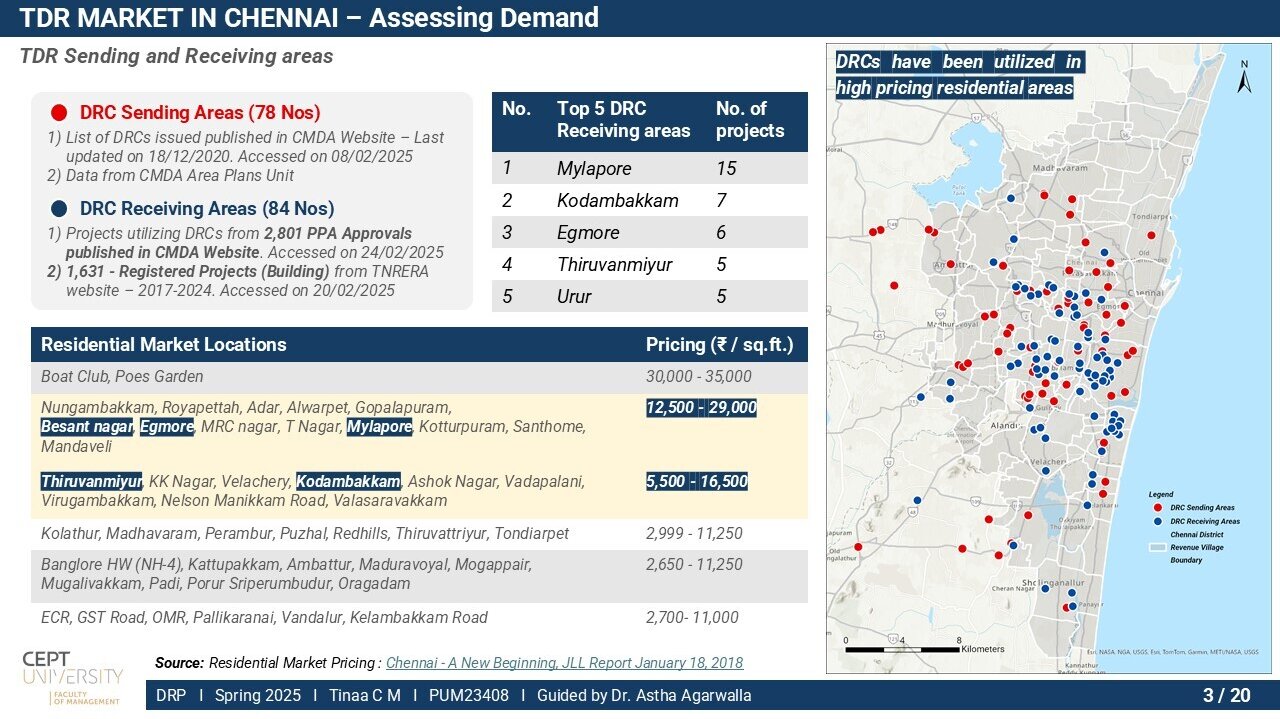
The study adopts a systematic, multi-layered approach to understand TDR utilization in Chennai. It begins with data collection from three primary sources: 2,801 Planning Permission Applications from CMDA (2016–2025), 1,631 registered real estate projects from TNRERA (2017–2024), and a limited dataset of TDR-utilized projects provided by CMDA’s Area Plans Unit. The data was cleaned, standardized, and classified based on key parameters such as FSI type, number of units, road width, guideline value, and DRC usage. Quantitative analysis, including descriptive statistics and correlation testing, was conducted to identify significant factors influencing developers’ decisions to use TDR. Spatial mapping of 78 sending areas and 84 receiving areas was carried out to examine locational patterns and potential development corridors. The approach integrates financial, regulatory, and spatial dimensions to assess TDR both as a value capture mechanism and as a tool for transferring development rights. Insights from the analysis inform targeted recommendations for key stakeholders.
The study proposes stakeholder-specific recommendations to strengthen TDR utilization in Chennai. For real estate developers, transparency must be improved through an online platform providing updated information on all DRCs issued, easing the process of identifying DRC holders. For the development authority, policy reforms should incentivize developers to use TDR for shifting development potential from high-density to low-density areas, emphasizing targeted and balanced urban growth rather than relying on TDR solely as a revenue tool. The planned introduction of Green TDRs should proceed only after a detailed review of regulatory frameworks, implementation models, and lessons from other cities to ensure context-sensitive deployment. Additionally, the authority should encourage TDR use among smaller projects and in lower-value areas to deepen and widen the market. For DRC holders, strengthening TDR requires the authority to address price distortions created by the coexistence of Premium FSI Charges and DRC Utilization Charges, enabling a more efficient and equitable market.
- tina cm
Gallery