- Published by:
- CEPT University Press
- ISBN Number:
- 978-93-83184-95-8
- Publications Year:
- June, 2025
- Actual cost:
- ₹2,500/-
- jaimini mehta
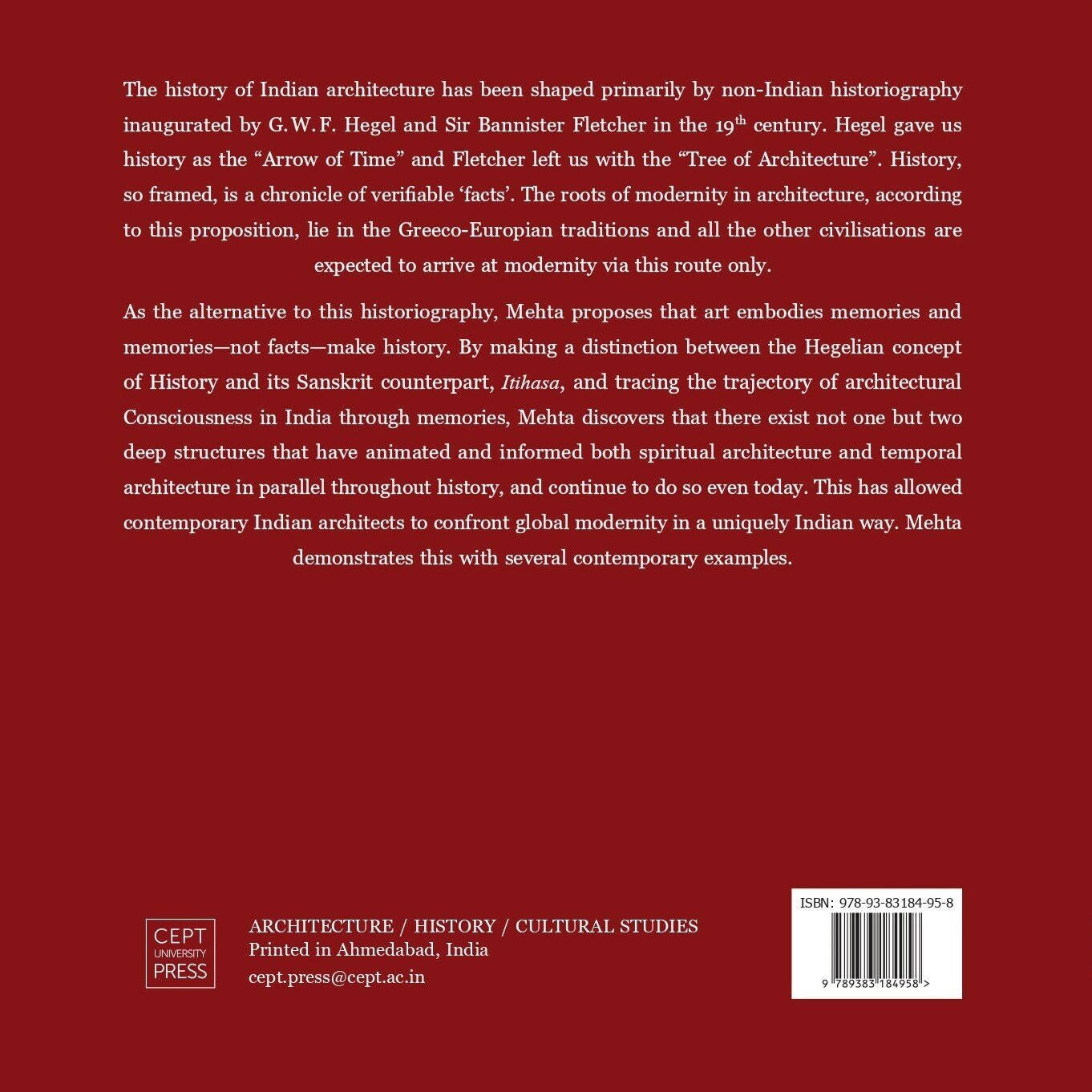
The history of Indian architecture has been shaped primarily by non-Indian historiography inaugurated by G.W.F. Hegel and Sir Bannister Fletcher in the 19th century. Hegel gave us history as the “Arrow of Time” and Fletcher left us with the “Tree of Architecture”. History, so framed, is a chronicle of verifiable ‘facts’. The roots of modernity in architecture, according to this proposition, lie in the Greeco-Europian traditions and all the other civilizations are expected to arrive at modernity via this route only.
As the alternative to this historiography, Jaimini Mehta proposes that art embodies memories and memories-not facts-make history. By making a distinction between the Hegelian concept of History and its Sanskrit counterpart, Itihasa, and tracing the trajectory of architectural Consciousness in India through memories, Mehta discovers that there exist not one but two deep structures that have animated and informed both spiritual architecture and temporal architecture in parallel throughout history, and continue to do so even today. This has allowed contemporary Indian architects to confront global modernity in a uniquely Indian way. Mehta demonstrates this with several contemporary examples.
- jaimini mehta