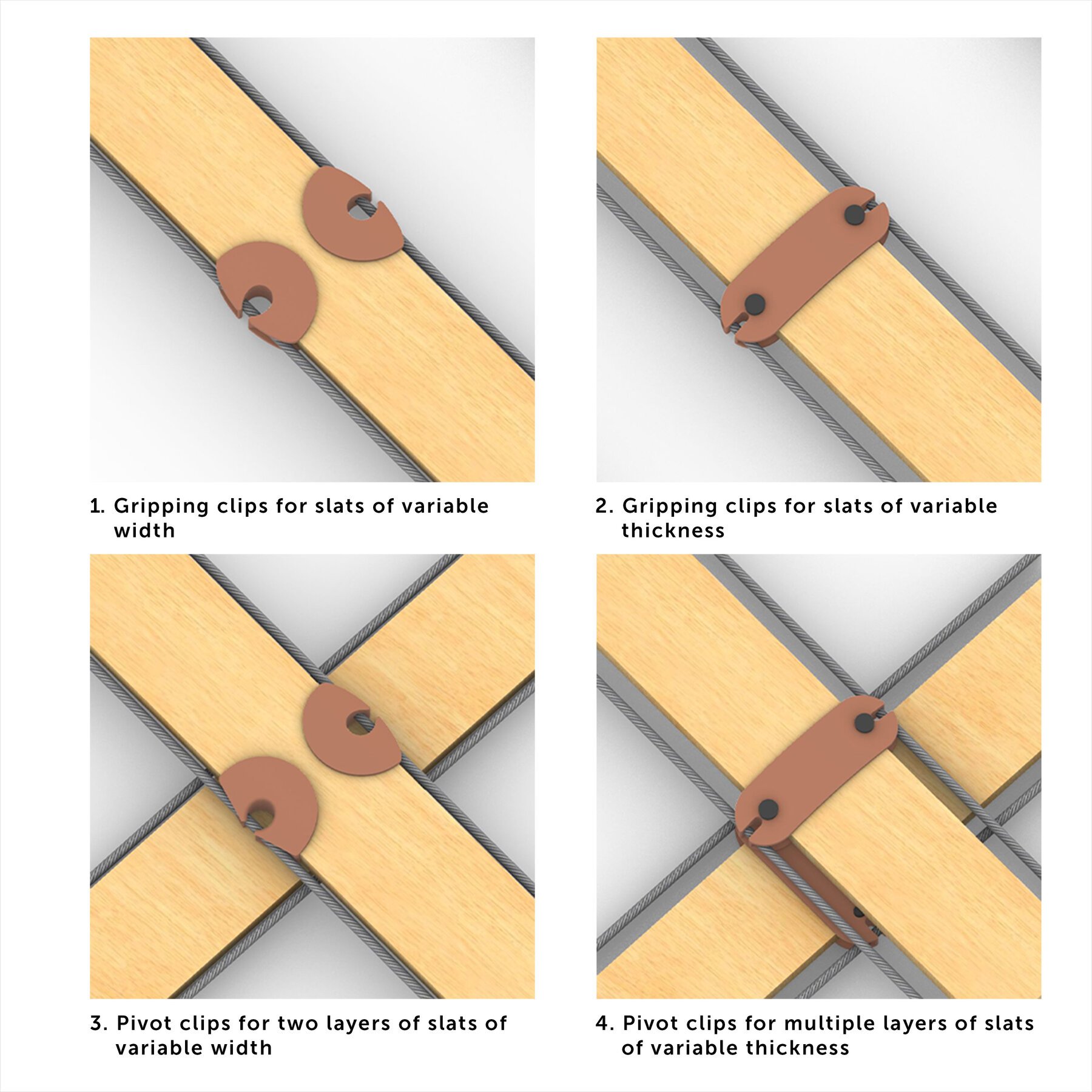
The system comprises four types of fasteners, including gripping and pivot clips, designed to accommodate slats of varying widths and thicknesses. It enables the assembly of bamboo and timber slats in single or multiple layers, supporting the creation of lightweight, modular, and curved structural forms increasingly relevant in contemporary sustainable architecture.
Conventional fastening methods typically fix bamboo slats at their centre, leading to stress concentration and eventual fracture under load. The newly developed flexible fastener system reconfigures this approach by shifting connections to the edges of the slats. This allows forces to be distributed more evenly, leveraging bamboo’s higher tensile strength and improving overall structural performance.
Elaborating on the functioning of the product, Sankalpa, Associate Professor, Faculty of Architecture, said, “Bamboo is among the most carbon-sequestering construction materials, offering rapid renewability, high strength, and a significantly lower environmental footprint compared to conventional building materials. However, its wider adoption in mainstream construction has been constrained by the absence of fastening systems designed specifically for its structural behaviour. This invention responds directly to that challenge by developing a system grounded in bamboo’s intrinsic material logic, while also extending its application to timber.”
This is the first patent to emerge from an ongoing research initiative at CEPT, which aims to address a critical gap in bamboo construction — namely, the lack of reliable, standardised fastening systems aligned with the material’s inherent properties.
The patent represents an important milestone in the University’s broader research trajectory towards developing scalable, standardised construction systems using natural materials. It signals the emergence of a more robust technical framework that can support the integration of bamboo into mainstream building practices with greater confidence and reliability.