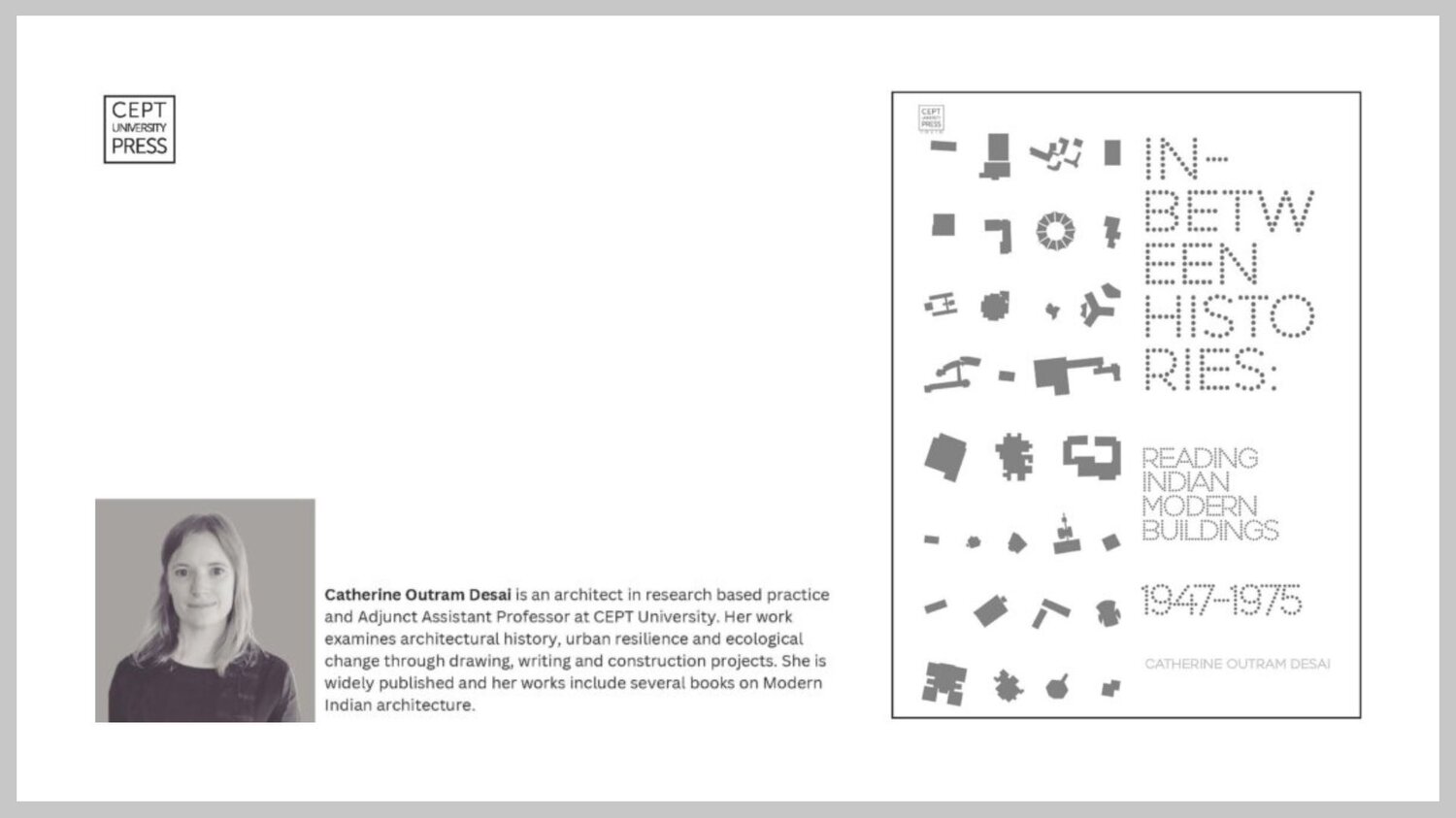
Catherine is an architect, academic and author. After practicing in London, she commenced research and teaching in Ahmedabad in 2015. Across her studios and courses in Masters and Undergraduate design and history programs she uses large scale drawings, models and mockups as tools of analysis, critique and design. Her academic interests include: the object of the building in architectural history and theory, 20th century Indian architecture, circularity and climatic resilience, and ecology and infrastructure. Catherine is the author of 3 books on modern Indian architecture and essays for OASE, Curator, Routledge and others.
Catherine graduated with First Class Honours from the Royal Melbourne Institute of Technology. She has many years of practice experience in India, Australia and the UK where she has worked for BV Doshi, Sen Kapadia and Hopkins Architects as well as in private practice. Significant projects include a temporary school in Mumbai for Gujarat Research Society and at while at Hopkins, a new courtyard and modifications to the Royal Academy of Arts, London.Catherine has been in academia since 2017. She leads studios in Masters and Undergraduate programs and teaches undergraduate history courses. Her Masters studio focusses on the significance of the architectural object in the writing of history and uses drawing as means of analysing buildings in order to expand and question established historic and critical ideas. Her Undergraduate studio has since 2023 examined how speculative design can be used to address problems of climatic resilience in informal settlements in India, contexts of great need. She is also involved in developing and prototyping retrofit proposals beyond the studio context, with the first constructed in 2025 as part of the CEPTSWS program.Catherine is the author of three books on Modern Indian architecture, and her writing has been widely published in national and international journals and in conference proceedings.
Architectural History, Theory and Criticism (Modern Indian Architecture)
Architectural Design
Design for Climatic Resilience and Circularity
Indian Urban Landscapes
Drawing as Research Method
Land Stories — S‑2026
Land Stories — S‑2026
Theorizing Architectural Production — S‑2025
History of Urban Form — M‑2025
HRW1 — Typology — M‑2025
Resilience Thrift: Repairing for Climate Change — M‑2025
Resilience Thrift: Design Build Retrofits for Informal Ahmedabad — W‑2025
Theorizing Architectural Production — S‑2024
Symposium
Back to the BuildingArchitecture Method: KRVIA Symposium 2026
Book Presentation: In-between Histories: Reading Indian Modern BuildingsArchitecture Method KRVIA Symposium 2026
Drawing as ResearchIPSA Mélange ’23
Conference
Book Presentation In-between Histories: Reading Indian Modern Buildings 1947 – 1975Site Lines Talking Architecture in the Subcontinent
Questioning the tabula rasa in Indian modernity: Towards a genealogy for the Anthropocene.MoHOA Modern Heritage in the Anthropocene. Bartlett School of Architecture University College London
Transient Extractions: Negotiated Ecologies of Salt Production in Colonial IndiaSAH79th International Conference Mexico City
First Works: Charles Correa in GujaratZ‑Axis: Conversations with Charles Correa
Resilience Thrift: Retrofit Strategies for Climate Risk in Irregular Settlements8th International Network of Tropical Architecture (iNTA) conference on Climate Justice and Resilience: An Interdisciplinary Dialogue
Conference Proceedings
Cultural Transplants: The legacy of Mies’s urban strategies in India.Mies Van Der Rohe The architecture of the city: Theory and Architecture, Politecnico di Milano 2022
Questioning the tabula rasa in Indian modernityBartlett School of Architecture — MoHoA Modern Heritage in the Anthropocene
Other
PATIO Conversation 16: Landscape, Ecology and EnvironmentPATIO Conversation 16: Landscape, Ecology and Environment
Patio Conversations 08: Landscape, Ecology and EnvironmentPatio Conversations 08: Landscape, Ecology and Environment
Seminar
Research Frameworks within the Architectural FieldSite Lines Talking Architecture in the Subcontinent